The Agreement That Changed Everything
Why Franchising Matters to America’s 250th Anniversary—and Always Has
By Michael Seid, Managing Director, MSA Worldwide
A Fable — Once Upon a Time — in an Alternative Universe
Once there was a printer named Benjamin Franklin, and he was a brilliant and jolly man who made friends everywhere he went. By 1776, Ben was the most celebrated intellectual in the Colonies — but he had one big problem: he was near broke and lived from one almanac sale to the next.
You see, Benjamin never got around to franchising his printing system, so he worked every day of his adult life in his print shop in Philadelphia, feeding the press and checking the proofs and managing the accounts. The money he made went to his employees and his rent and his ink and his paper, and he was comfortable in a colonial fashion — but when Congress came to him in 1776 and said, “Ben, we need you to go to France and negotiate an alliance,” he couldn’t go.
“I have no money for passage,” he told them. “I’ve worked my entire life and have nothing saved. Besides, who will run my shop if I leave?”
So Congress sent someone else — a younger man, charming but unknown. The French didn’t recognize him and didn’t trust him, and since Congress had no money for him to stay long, the negotiations failed. The Continental Army went hungry, Washington lost the war — and because franchising had never taken root in the colonies, in 2026, as you read this fable, you are a subject of King Charles III and Camilla is your Queen.
The World Without the American Revolution
To be fair to my British friends: Britain would probably have been more than fine. With a stable and productive American colony providing raw materials, trade, and loyal subjects, the British Empire becomes even more dominant, the royal line continues unbroken, and life goes on — orderly, respectable, and thoroughly British.
But here’s what America never gets to become.
The lightning rod stays theoretical. The bifocals stay imperfect. The Franklin stove remains a curiosity in one Philadelphia shop. These aren’t the real loss, though.
The colonies never become a nation. They never write their own Declaration. They never experiment with the radical idea that ordinary people could govern themselves. The Industrial Revolution stays British. Innovation stays British. Wealth flows to London and the future flows to London — and in a Philadelphia print shop, an aging Benjamin Franklin works every day, living one almanac sale to the next, never retiring, never inventing, never having the luxury of time to think.
The American dream — the idea that you could start small, scale big, franchise your system, and buy your freedom with the proceeds — never occurs to anyone, because the man who would have invented it never had the chance.
That could have been the end of the story. Except it’s not.
Here’s What Actually Happened
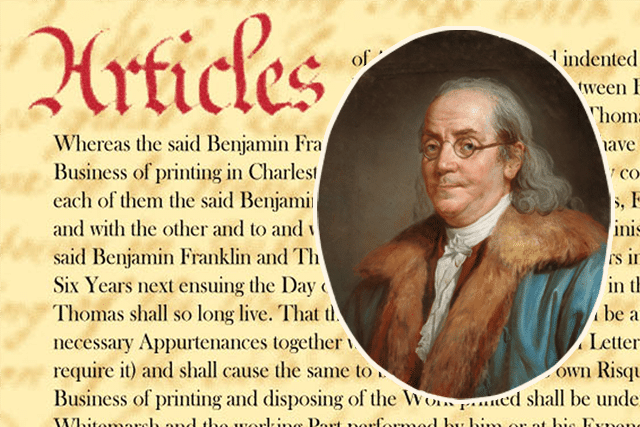
In 1731, Benjamin Franklin made a different choice. At twenty-five, he entered into a co-partnership with Thomas Whitmarsh, a journeyman printer. Franklin supplied the system and the press; Whitmarsh supplied the labor; and in exchange, Whitmarsh paid Franklin one-third of the revenues for the life of the agreement. They called it a co-partnership, but history calls it franchising — and what Franklin figured out that year became the foundational business model of modern commerce.
By 1748, the model had compounded across the colonies and into the Caribbean, and the recurring royalties from his printing franchises meant that at forty-two, Benjamin Franklin could retire. He didn’t have to work another day in his life — so he didn’t.
With his time his own, Franklin conducted the kite experiment, designed the lightning rod, invented the Franklin stove and bifocals, served in the Pennsylvania Assembly, and spent years in London building the relationships that made him the most famous American in the world. When Congress came to him and said, “We need you to go to France,” Franklin could say yes — because he had no shop that needed minding, no daily labor that couldn’t wait, and no money worries.
At seventy, an old man in a fur hat walked into the court of Louis XVI and charmed a nation into war. The French fleet that closed the trap at Yorktown in 1781 was Benjamin Franklin’s handiwork — negotiated by a man who had the luxury of not needing a paycheck. Without the franchise, there is no free time. Without free time, there is no diplomatic mission. Without the mission, there is no alliance. Without the alliance, we lose the war — and you are British.
The Moral of the Story
Franchising created the wealth that purchased Benjamin Franklin’s freedom. That freedom made him a statesman. That statesman won an alliance. That alliance won a war. That war created a nation.
In 1731, no one called it franchising and no one had written the rules yet — but the architecture was there: license your system, take a percentage of the profits, let that percentage compound, buy your freedom with it, and use your freedom to do something larger than yourself.
This July Fourth, as we celebrate 250 years of independence, we should also raise a glass to the franchise agreement signed in Philadelphia in 1731 — the day Benjamin Franklin chose to let someone else run his business so he could change the world.
How to Celebrate the 250th
Walk into your local franchise — the Firehouse Subs in your neighborhood, the Dunkin’ down the street, the Great Clips where your kids get haircuts. Look around and understand what you’re seeing: the Franklin model, still running. Someone who had a dream and decided to scale it; someone else who trusted that dream enough to operate it. Employees whose paychecks exist because that business does.
Buy something. And if you get the chance, talk to the owner. Ask what brought them to franchising — because their answer will echo Franklin’s story. A system that worked, a way to scale it, freedom purchased through that scaling. Dreams built on the foundation of that freedom.
That person’s story is your American story, and it runs in a direct line back to Philadelphia, 1731.
Somewhere right now, someone is deciding whether to franchise their system — and someone else is deciding whether to invest in one. Those choices might just change the course of history.
They always have.
Michael Seid is the Founder and Managing Director of MSA Worldwide, a long-serving member of the International Franchise Association’s Board of Directors, and co-author of Franchising for Dummies and Franchise Management for Dummies.